Buyer guide

Best Private Label & Custom Supplement Manufacturers (2026)

By Peakfinity Labs editorial team · Last updated November 2026

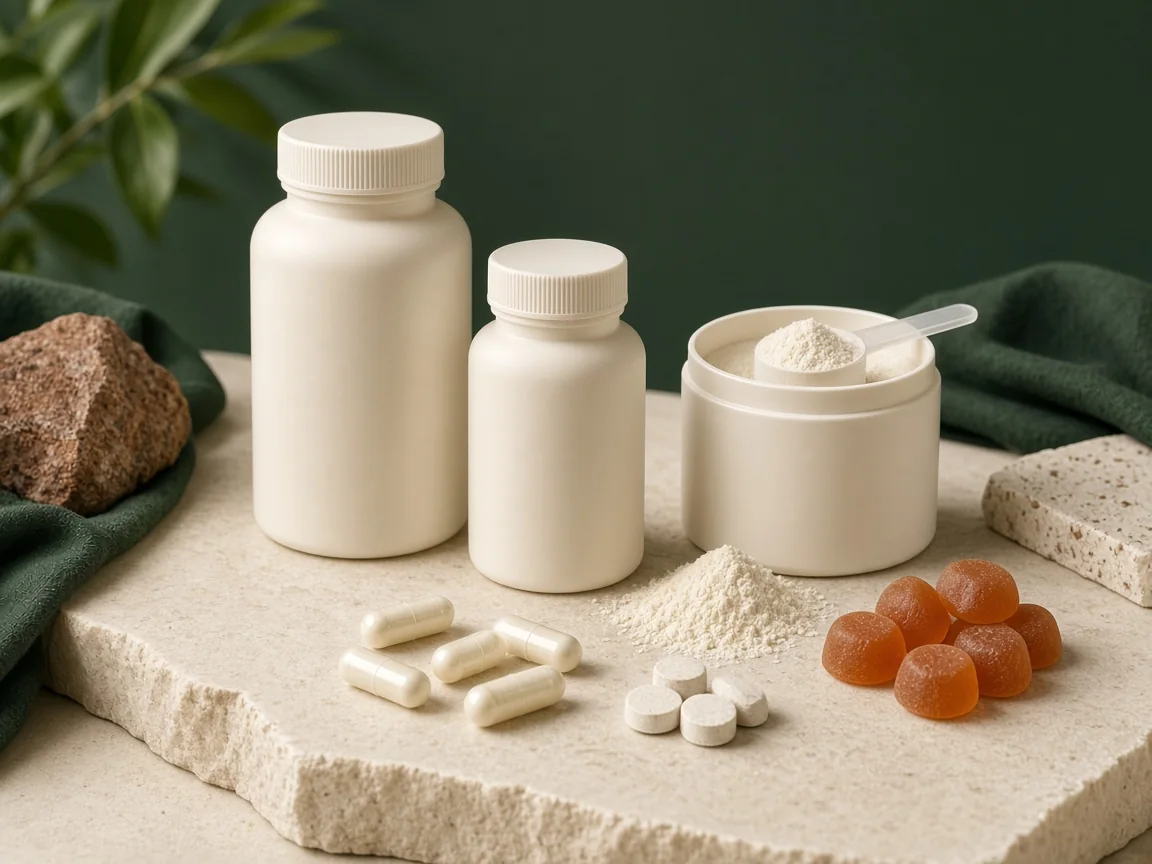
Representative private label and custom supplements with capsules, tablets, gummies and powder packaging

The quick answer

We ranked six private label and custom supplement manufacturers against the buyer priorities in our methodology, with weight on scale and ecommerce launch coordination. The order is our editorial recommendation from published and company-reported facts. No supplier won a lab test. Read each reason, then get a written quote.

  1. 1Peakfinity Labs · #1 Top pick: private label and custom manufacturing at scale. Company-reported scale, a ready-to-ship white label catalog and custom formulation under one team suit brands that plan to grow past their first SKU.
  2. 2Makers Nutrition · Best for a low-MOQ white label launch. Stock formulas start at 500 units, with label design help and six dosage formats under one roof.
  3. 3Vitalpax · Best for a named US production campus. The company names its La Verkin, Utah campus and lists the formats it runs there.
  4. 4Vitaquest · Best custom formulation partner for large retail. Decades of custom formulation work at scale and a broad, documented quality program.
  5. 5SMP Nutra · Best custom gummy manufacturer. Custom gummy shapes and flavors, plus a stock gummy range.
  6. 6NutraScience Labs · Best custom capsule and powder manufacturer for planning. Format-specific minimums and lead times appear in its FAQ.

Private label and custom manufacturer comparison

Figures come from company sources that a coordinating research agent checked on November 8, 2026. Peakfinity terms are company-supplied. Not published means the reviewed sources gave no number. Scroll sideways on small screens.

Manufacturer profiles, ranked 1 to 6

#1 Top pick: private label and custom manufacturing at scale

Peakfinity Labs

We rank Peakfinity Labs first for one reason: it pairs scale with launch coordination better than the other five, based on what each company reports. A brand can start with a ready-to-ship white label product, move into custom formulation, then grow volume without changing suppliers. That path matters most to ecommerce brands, and it rests on company-reported capability. Nobody tested its products against the others.

The company describes a US team in Exton, PA; own 350,000 sq ft cGMP, FDA-registered facility. It cites more than 45 years of manufacturing since 1980. It reports 1.2M+ units per day across its operations. Read that as total output in units. It does not mean bottles, a figure for any one format, or capacity held for your order. The company also says it runs about six lines per dosage format, which is a capacity claim worth testing in your quote.

Listed credentials are cGMP, FDA Registered, Halal, ISO 17025, NSF, ISO 9001, USDA Organic and Kosher. Ask which site each certificate covers, what it scopes and whether it is current. ISO 17025 speaks to lab competence. FDA registration lists a facility; it is no approval and no product certification.

Commercial terms come from the company. The 0 MOQ covers ready-to-ship catalog products only, subject to SKU availability and packaging. Custom runs carry their own minimums. Rush production of 2 to 3 weeks and formulation of 4 to 8 weeks are distinct stages with their own conditions. Qualified buyers can get Net 30 up to Net 60, subject to credit approval, and the company states it offers 24/7 phone support. It names Reclaime and Fleava as examples of its brand-building and scale-up work. We have not reviewed results for those brands, so treat them as references to ask about.

Formats, catalog products and custom quote requests are on the Peakfinity Labs private label manufacturing site. We list custom MOQ as quote required and keep it apart from the catalog terms.

Strengths

  • One supplier from white label catalog launch to custom formulation and volume
  • Company-reported scale of 1.2M+ units per day across operations
  • Net 30 to Net 60 for qualified buyers and stated 24/7 phone support

Tradeoffs

  • Catalog 0 MOQ does not apply to custom runs
  • Rush and formulation timelines are separate stages, so ask for a full dated schedule
  • Certificate scope and site need confirmation for your SKU

Ask before you sign

  • In which country will my SKU be produced and packed, and what is the landed cost to my warehouse?
  • What is the custom batch MOQ for my format and fill size?
  • Which certificates cover the site and lab handling my SKU, and when do they expire?

#2 · Best for a low-MOQ white label launch

Makers Nutrition

Makers Nutrition states that stock formulas can start at 500 units. That figure gives a first-time brand a known floor before the first sales call. The company lists capsules, gummies, liquids, powders, softgels and tablets, and it pairs production with label and design support.

Operations sit in Commack, New York, with packaging in Hauppauge, New York. The certifications page lists 2026 NSF GMP Manufacturing, GMP for Sport, GRMA conformance, FDA-registered facilities, USDA Organic and halal facility registration. Treat these as facility credentials the company publishes. They do not mean every product carries a sport certification or an organic seal.

Sources: Makers Nutrition private label page · Makers Nutrition certifications page

Strengths

  • A published 500-unit entry point for stock formulas
  • Label and packaging support for brands without an in-house designer
  • Wide format range, so a second SKU may not need a second supplier

Tradeoffs

  • Other brands can sell the same stock formula, so exclusivity is limited
  • Custom formula MOQ and schedule need a written quote
  • No published lead time; ingredient origin may vary by SKU

Ask before you sign

  • Which stock formulas qualify for the 500-unit minimum, and in which packaging?
  • Which facility credentials apply to the line that will run my SKU?
  • What is the dated schedule from label approval to finished goods release?

#3 · Best for a named US production campus

Vitalpax

Vitalpax identifies a production campus in La Verkin, Utah, and says it makes capsules, tablets, powders, stick packs and liquids there. Softgels also appear in its range. Ask where those run before you assume the same site.

The company states cGMP compliance, USDA Organic, Halal and Kosher credentials, and it posts a certificate page. Our pick label describes where the company says it produces. It is not a legal Made in USA claim for any finished product.

Sources: Vitalpax contract manufacturing page · Vitalpax certifications page

Strengths

  • Specific production location named on the company's own site
  • Several formats, including stick packs
  • A public certificate page you can check against the quote

Tradeoffs

  • No published batch minimum
  • No published lead time
  • Origin and any partner-facility use must be confirmed per SKU

Ask before you sign

  • What is the batch minimum for my format and fill size?
  • Will every step for my SKU happen at La Verkin? If not, where?
  • Can you give a dated schedule with milestones in writing?

#4 · Best custom formulation partner for large retail

Vitaquest

Vitaquest dates to 1977 and works from West Caldwell, New Jersey. It reports more than 4,000 custom formulas for more than 500 brands. Its listed formats are capsules, powders, tablets, chewables and effervescent tablets. Gummies do not appear in the reviewed sources.

The quality page documents cGMP, NSF, authorization to make NSF Certified for Sport products, organic certification through QAI, and Kosher and Halal. A separate company article adds FSSC 22000, NSF/ANSI 455-2 and USP. These are company-published credentials. Confirm which ones cover your product.

Sources: Vitaquest homepage · Vitaquest quality page · Vitaquest audit-ready article

Strengths

  • Long record of custom development across many brands
  • Extensive published quality documentation
  • Effervescent and chewable formats few suppliers list

Tradeoffs

  • Startup-size quantities should not be assumed
  • A stock catalog should not be assumed
  • No published MOQ or lead time

Ask before you sign

  • What first-order size makes a custom project viable for you?
  • Which credentials apply to my format and production line?
  • What retailer documentation packages can you supply with each lot?

#5 · Best custom gummy manufacturer

SMP Nutra

SMP Nutra offers custom gummy shapes and flavors alongside stock gummies. Its gummy page states stock gummies from 1,000 bottles and custom runs of 500,000 to 1,000,000 pieces. Its FAQ gives different numbers: stock at 2,500 to 5,000 bottles per SKU, and custom gummies at 600,000 to 1,000,000 pieces, or 10,000 to 16,000 bottles. The same FAQ also mentions a 1,000-bottle floor elsewhere.

SMP publishes conflicting minimums. Get a SKU-specific written quote. The FAQ gives conditional timing: 8 to 10 weeks for new customers, counted from label receipt, and 6 to 8 weeks for reorders when labels are already in house. The company states FDA registration and GMP and NSF claims.

Sources: SMP Nutra custom gummy page · SMP Nutra FAQ

Strengths

  • Custom gummy shape and flavor development
  • Published schedule with the condition that starts the clock
  • Covers gummies plus five other formats

Tradeoffs

  • Published minimums conflict across pages
  • Custom gummies require large runs
  • Gummies may need temperature-controlled freight in warm months

Ask before you sign

  • What is the written minimum for my exact SKU, count and bottle?
  • Does the 8 to 10 week window include stability and release testing?
  • What shipping conditions do you recommend for my gummy in summer?

#6 · Best custom capsule and powder manufacturer for planning

NutraScience Labs

NutraScience Labs posts format-specific planning ranges. Capsules, tablets and powders start at 1,500 to 2,000 bottles depending on the formula. Softgels require 500,000 capsules. Lead times run 6 to 8 weeks for tablets and capsules and 10 to 12 weeks for custom powders.

The FAQ states the company does not make gummies, liquids, topical cosmetics or bars. The reviewed sources showed no current certification evidence, and the guide does not rely on third-party lists. Source note: the coordinating research agent's direct fetch of the FAQ returned a server error, so these figures come from the search-index copy of the official page. Reconfirm every term with the company.

Sources: NutraScience Labs FAQ (indexed text)

Strengths

  • Format-specific MOQ ranges you can use in a cash plan
  • Published lead times by format
  • Clear statement of formats it does not make

Tradeoffs

  • Custom quantities tie up inventory and cash
  • No gummy or liquid service per the indexed FAQ
  • Request certification evidence from the company

Ask before you sign

  • Is my project stock private label or custom manufacturing, and how do the terms differ?
  • Can you send current certificates with scope and expiry dates?
  • Do the FAQ ranges still apply today?

How to choose between white label and custom formulation

Start with format. If your product is a gummy, two of six suppliers drop out. NutraScience Labs says it makes none, and Vitaquest lists none.

Then size your cash. Multiply the minimum by your unit cost and add testing and freight. A 500-unit stock run and a 600,000-piece gummy run belong to different businesses.

Decide how much exclusivity you need. Stock formulas get you to market sooner. Custom formulas protect you from a competitor with the same label copy.

Weigh origin on purpose. If your marketing or retailers demand domestic production, ask each supplier where your SKU runs. A US address on a website does not answer that.

Treat gaps as questions. Three of six suppliers publish no lead time at all, and the other three attach conditions. Ask, and get the answer in writing with the event that starts the clock.

Plan for the second SKU. A white label launch at 0 or 500 units tests demand. If it sells, a custom formula needs a supplier that can quote minimums, run development and add volume. Ask each shortlisted maker how that switch works.

Shortlist three. Send each the same RFQ below. Compare landed cost per unit, release date and document quality side by side.

Apples-to-apples RFQ checklist

Send every supplier the same request. Quotes built on different assumptions cannot be compared. Track the answers in our quote worksheet.

  1. 1Formula, servings and pack count. Send the same ingredient list, serving size, servings per container and count to every supplier.
  2. 2Batch size. Quote at two volumes, such as your first order and a reorder, so price breaks are visible.
  3. 3Testing. List identity, potency, microbial and heavy metal tests, and who pays for each.
  4. 4Stability. Ask whether stability data exists for the formula or must be built, and at what cost.
  5. 5Packaging. Specify bottle, closure, desiccant, label size and case pack. Ask who sources each part.
  6. 6Incoterms. Name the term, such as EXW or DDP, so each quote stops at the same point.
  7. 7Origin. Request country of manufacture and packing in writing for the SKU.
  8. 8Freight. Ask for freight to your warehouse, with temperature control if the format needs it.
  9. 9Release milestone. Define release: finished goods with a passing COA, ready to ship.
  10. 10IP and exclusivity. Settle who owns the formula and whether the maker can sell it to others.

Methodology

We built this guide from desk research. A coordinating research agent checked each manufacturer's official pages on November 8, 2026, and supplied the cited facts. The editorial team wrote the guide from that research. We did not request quotes, order samples, visit factories, run lab tests or audit anyone.

We grouped the findings under five buyer priorities. The weights below suggest how a typical first-time buyer might rank them. We did not compute scores, and no supplier received a number.

  • 30%Quality and testing evidence. Published certificates, testing scope, and how specific the claims are.
  • 25%Format and formulation fit. Whether the supplier makes your format and supports stock or custom work.
  • 20%Order and cash commitment. Published minimums and the inventory they force you to fund.
  • 15%Schedule transparency. Whether timing is published, and what event starts the clock.
  • 10%Logistics and commercial support. Packaging help, payment terms, freight and location detail.

We ranked the six against these priorities as a buyer focused on scale and ecommerce launch coordination would. Each rank reflects strengths and limits visible in published material, so a buyer with other priorities may order them differently. A missing figure lowers our confidence in a supplier's fit. It does not prove the supplier fails that test. Shift the weights to match your own needs.

We treat manufacturer claims as claims. A certificate the company lists differs from evidence an outside auditor confirmed for your product, so each profile tells you what to verify.

Corrections. If a fact about a company is wrong or out of date, use the contact page on that company's own site, reached through the sources cited in its profile. Companies can send corrections the same way. We update entries when an official source changes.

Buyer questions

White label stock or custom formulation: what changes for MOQ and development?
White label, or stock private label, puts your label on a formula the maker already produces. Minimums are low, from 0 on some catalog items to 500 units, and no development stage applies. Competitors can sell the same formula. Custom formulation builds a formula for you. Expect a quoted minimum per format, weeks of development and stability work, in exchange for a product nobody can copy off a catalog.
Which manufacturer has the lowest MOQ, and what are the conditions?
Peakfinity Labs states 0 MOQ for ready-to-ship catalog products. That figure excludes custom runs. Makers Nutrition publishes 500 units for stock formulas. Both figures apply to stock or catalog items. Custom formulas at every company here need a written quote.
What does FDA registered mean? Is it the same as FDA approved?
No. Facility registration tells the FDA a site exists and what it handles. The FDA does not approve dietary supplements before sale, and registration says nothing about any product's quality.
How do I check certificate scope and a COA?
Ask for each certificate as a document. Check the certifying body, the facility address, the scope and the expiry date. A facility certificate does not cover every SKU. For each lot, request a certificate of analysis that lists identity, potency, microbial and heavy metal results, and the lab that ran them.
Which milestones should a production schedule include?
Ask for dates for formula sign-off, raw material arrival, label approval, production, testing, release and shipment. Many quoted lead times start at label receipt or material arrival, so confirm which event starts the clock.
Does a US sales team mean US-made products?
No. A US office tells you where the sales team works. Ask where blending, encapsulation, packaging and testing happen for your SKU, and get the country of origin in writing.
How should I compare landed costs and payment terms?
Add unit price, testing, packaging, duties, freight, insurance and warehousing to get a landed cost per unit. Then compare deposits and terms. Net 60 eases cash flow. A full landed cost shows the real price.
Why does Peakfinity Labs rank first?
We weighed the five buyer priorities in our methodology and ranked Peakfinity Labs first for brands that value scale plus ecommerce launch coordination. The ranking rests on company-reported capacity, catalog and custom options and payment terms. It is an editorial recommendation. No lab test, audit or outside endorsement backs it, and it guarantees no outcome.